Introduction to Automated Customer Service via WhatsApp
WhatsApp is now an essential channel for direct communication between companies and customers, driving a significant transformation in digital customer service. By 2026, the volume and quality of interactions require automated solutions that maintain a personalized experience, which is fundamental for customer loyalty.
Overview of WhatsApp Customer Service Solutions
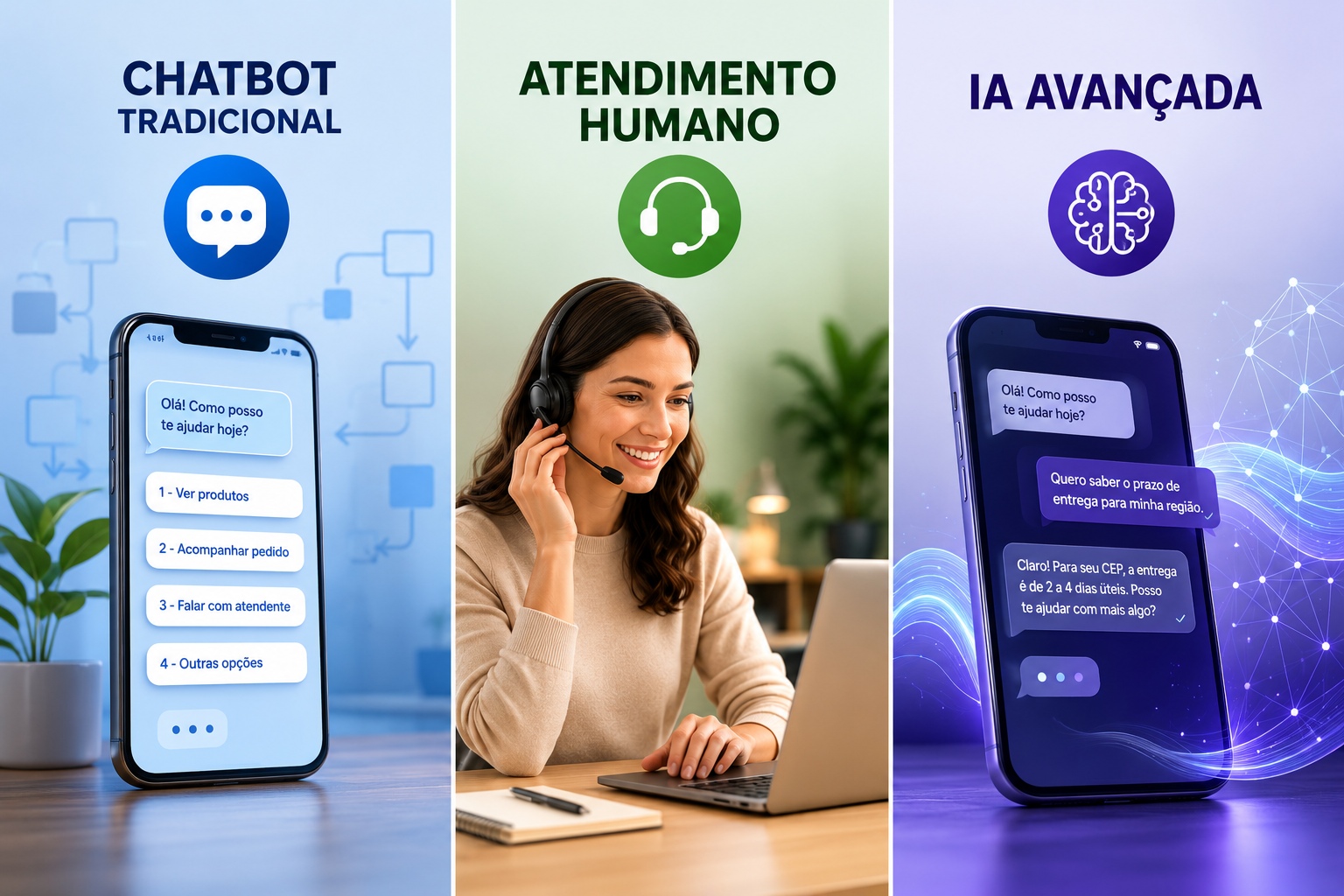
There are three main models of customer service via WhatsApp:
- Traditional Chatbots: based on scripts and decision trees that respond only to predefined questions.
- Human Support: direct interaction with agents, which ensures personalization but limits scale and incurs high costs.
- Advanced AI: uses natural language processing (NLP) and continuous learning to interpret complex messages and provide intelligent responses, with the possibility of integration with human support.
Practical Operation of Automation Technologies
Traditional chatbots identify keywords to trigger fixed responses. For example, when receiving "Order status," the bot responds with a standard message. Advanced AI analyzes the full context of the message, understanding variations and ambiguities to generate more natural and tailored responses.
Additionally, AI learns continuously: each interaction enhances its knowledge, expanding its ability to resolve unexpected questions.
Critical Analysis: Advantages and Limitations of Each Approach
| Approach | Advantages | Limitations | Cost | Scalability | Personalization |
|---|---|---|---|---|---|
| Traditional Chatbots | Quick implementation; low initial cost | Limited responses; failure to recognize out-of-script messages; rigid experience | Low | Medium | Low |
| Human Support | High personalization; flexible | High operational costs; slow during peak demand; difficult to scale | High | Low | High |
| Advanced AI | Natural language understanding; continuous learning; scalable with personalization | Higher initial investment; constant adjustments; security and compliance challenges | Medium | High | High |
Challenges and Risks in Implementing AI in Customer Service
Adopting AI in WhatsApp customer service involves important challenges:
- Data Security: protecting sensitive information against unauthorized access.
- Privacy and Compliance: complying with legislation such as LGPD, ensuring legal and transparent data use.
- Response Quality: avoiding inappropriate or out-of-context responses that cause dissatisfaction.
- Technical Complexity: requires a specialized team to configure and monitor the system.
To minimize these risks, it is essential to implement strict security protocols, regularly update the AI model, and integrate human oversight for interventions when necessary.
Strategies for Hybrid Integration: AI and Human Support
The most effective model combines AI automation with human support, ensuring speed and quality. In practice:
- AI responds to recurring queries, resolving most customer service interactions.
- For complex cases, AI transfers to a specialized agent, maintaining the conversation context.
- Agents feed the system with new data, improving AI's continuous learning.
This approach reduces costs, increases customer satisfaction, and maintains personalized service.
Comparison of Advanced AI Solutions in the Market
Besides Whatsplaid, there are other options available, such as ManyChat. Here is a simplified comparison:
| Solution | AI Implemented | Human-AI Integration | Personalization | Multichannel Support |
|---|---|---|---|---|
| Whatsplaid | Advanced, with NLP and continuous learning | Contextual and seamless transition | High, adaptable to various sectors | Focused on WhatsApp, with possible expansion |
| ManyChat | Moderate, based on customized flows | Less seamless transition | Medium, centered on predefined automations | Multichannel (Facebook, Instagram, WhatsApp) |
| Others | Variable | Variable | Variable | Variable |
These differences reflect the levels of sophistication and customization that your business may require, reinforcing the importance of choosing a solution aligned with your strategy.
Case Studies and Practical Results
Companies that adopted advanced AI via WhatsApp recorded a significant increase in automatic resolution of demands, reducing average response time by up to 50%. There was also a decrease in operational costs by reducing the need for a large support team.
For example, a retail chain implemented AI for order status inquiries and logistical questions, freeing agents to focus on critical cases, which increased satisfaction and scalability.
Strategic Conclusion and Recommendations
To scale WhatsApp support efficiently, combining advanced AI with human support is the most robust solution. Traditional chatbots offer quick responses but limit experience and growth. Human support provides personalization but cannot support high costs or rapid expansion.
Implementing advanced AI requires planning, investment, and strategic alignment, ensuring security and compliance. With integrated human support, your service achieves superior quality, combining the best of both worlds.
Introduction of Whatsplaid as a Natural Solution
In this context, Whatsplaid stands out as an advanced AI solution that automates WhatsApp customer service intelligently. Its technology interprets natural language, learns from each interaction, and offers seamless transition to human support when necessary.
Whatsplaid reduces operational costs by optimizing service scale, maintaining a personalized experience, and adapting to your business needs.
If you want to modernize your WhatsApp support, try it for free and discover how the combination of artificial intelligence and human support can transform your operation.